Showing posts with label Nuclear. Show all posts

Sunday, 5 January 2014

New work in progress

Here are a couple of new paintings I have been working on over the last few months and which are now finally approaching completion. The first painting is in two sections which are designed to be hung right up against each other. In the image below one section is hanging over the top of the other but you can hopefully imagine how they would look side by side from the shape of the piece in front (see the drawing below to get the idea). I need to find a suitably large free space in order to be able to hang and photograph the painting as I want it.


Nic Pehkonen, Yellow painting, (in progress), household emulsion paint on unstretched canvas, each section approx 6' x 6'
Nic Pehkonen, drawing design for yellow painting

As with most of my work, the ideas behind this painting have evolved over time from a variety of sources and subject matter so the reason it looks the way it does is mostly due to a visual coming together of this…

Orfordness, Lab 2 Blast-doors
and this…

Sizewell A, Perimeter wall section.
and this…

Uranium Oxide (Yellowcake)


The second work currently in the pipeline is:

Nic Pehkonen, Double Duct Pipe, 2013, 8' x 2' (approx), Household emulsion Paint on unstretched canvas

The idea for this painting comes from the pipes in the building below, the ends of which can be seen protruding at ground-level. I need to try and find out the exact function of these pipes within this test laboratory. Perhaps they were part of some sort of ventilation system? Either way, they look intriguing as they disappear into the wall. The tall cross-shaped openings set into the walls are going to feature in a new painting, which I have just begun.

Orfordness, View inside Lab 4


Sunday, 17 March 2013

Berkeley Boilers

On Saturday, the final two remaining boilers from the decommissioned Berkeley Nuclear Power Station began the first leg of their journey to Sweden, where they will be recycled.

Boilers leaving Berkeley (Photo:Magnox)

Two, 300+ tonne boilers on massive flatbed trucks, crawling along country roads makes for an impressive spectacle. Unfortunately, I missed it but you can see some footage that someone has kindly posted on the thisisgloucestershire website.

http://www.thisisgloucestershire.co.uk/VIDEO-Monster-Magnox-boilers-Berkeley-Nuclear/story-18433530-detail/story.html#axzz2NcTibURo

And here is a link to the BBC website which has three nice photos plus a little more detail  about the operation.

http://www.bbc.co.uk/news/uk-england-gloucestershire-21787508

Berkeley Nuclear Power Station (Photo:Magnox)

And if you feel the need for even more information, here is one final link, this time to the Nuclear Decommissioning Authority website...

http://www.nda.gov.uk/stakeholders/newsletter/berkeley-sets-the-pace.cfm

Tuesday, 31 July 2012

Orfordness

The ex-military test and research site at Orfordness on the Suffolk coast is an ongoing point of reference in my work . The combination of the wide-open landscape interspersed with an assortment of intriguingly shaped buildings and the footprints of structures long gone has resulted in a unique and fascinating mix of natural and man-made forms.


View across to the A.W.R.E site


Nic Pehkonen, Lab4a, 2009, Emulsion on unstretched canvas, 200cm x 60cm


For those who like their facts and figures, Orfordness is the largest vegetated shingle spit in Europe (approx 2000 acres in size and 10 miles long) and is also home to a lighthouse but it is more popularly associated with the history and architectural legacy of its military past.


Brick building with Orfordness lighthouse in the background


Land at Orfordness was purchased by the War Department just before the Fist World War and evolved over the years as a classified research and test site. Experiments were carried out on ballistics, camouflage, aircraft weapons lethality and vulnerability and also aerial photography. 


Bomb Ballistics Building

Orfordness also played it's part in the early pioneering development of radar and from the 1950s it played host to the Atomic Weapons and Research Establishment (AWRE) where a variety of unique buildings (laboratories) were constructed to perform tests on the (non-fissile) components of nuclear bombs. These buildings are arguably the most visually striking structures on the site with their unique, concrete forms decaying slowly in the surrounding shingle landscape.


Lab 4

Lab 4 roof

Nic Pehkonen, Lab4c, 2010, Emulsion on unstretched canvas, 200cm x 60cm

Inside one of the Test Laboratories

Nic Pehkonen, Inside Lab4, 2010, Emulsion on unstretched canvas, 183cm x 183cm

During the Cold War another part of the Orfordness site was developed in a collaborative effort between the US and UK governments to construct  a huge and massively powerful "Over-the-Horizon" radar designed to monitor military activity beyond the Iron Curtain. This project was codenamed "Cobra Mist" and although construction was completed (at enormous cost), it never worked properly and following a series of trials which failed to eliminate persistent background noise, the project was abandoned in early 1973.


Lab 1


Nic Pehkonen, Duct Pipe, 2009, Emulsion on canvas stretched over plywood (3 panels), 120cm x 120 cm


The AWRE site was also wound up in the early 1970s and apart from a very brief period of activity shortly after the Falklands War, Orfordness was effectively finished as a test establishment although a considerable amount of work was carried out to clear large amounts of live/unexploded ordnance left behind from decades of testing (and which is still being uncovered to this day!)


Lab 2 Blast Door


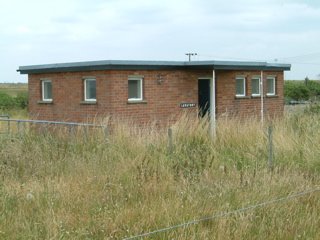
The site was eventually purchased by the National Trust in 1993 and was officially opened to the public in 1995. In my opinion the National Trust has done the right thing with the site. They have an enlightened approach and employed a zero restoration policy on most of the buildings and mercifully there is no horrible trademark shop or tearoom - just a very basic lavatory block in the way of facilities.


Lavatory Block

For those who want to find out more about Orfordness, I would definitely suggest a visit in the first instance. General opening times can be found on the National Trust website and I think there are still occasional guided tours where access is allowed to parts of the site not normally accessible to the general visitor. 

The Black Beacon - one of very few restored structures on the site.

I would also strongly recommend one of the very few books written about Orfordness. "Most Secret - The Hidden History of Orfordness" is by Paddy Heazell and published by The History Press in association with the National Trust.  Despite the fact that a lot of the work on Orfordness was secret he has nevertheless carried out a great deal of research and succeeded in putting together a fascinating history of the place, based on available information.
  

Friday, 15 June 2012

Sizewell

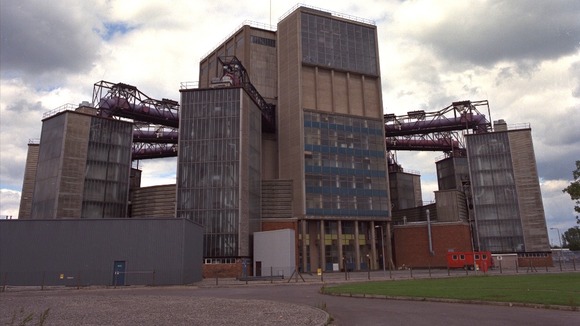
The Suffolk coastline is packed with interesting (and often unusual) places and buildings. Sizewell is definitely one of those places, where the two huge nuclear power stations (A and B), dominate the surrounding area. 


Sizewell A - main reactor building - view from the beach

I particularly love the imposing structure of the main reactor building of Sizewell A with it's massive concrete and metal clad walls. Whatever thoughts you may have regarding nuclear power and technology, this is certainly impressive architecture and it is a recurring point of reference in my own work.

from another angle...


 a closer view.

Nice, rusting exterior walkways

so much lovely concrete.

In fact, it is amazing just how close you can get to the site from the beach. You can walk right up to the perimeter wall and in some places you can get a reasonably good vantage point from which to look into the site.

Perimeter wall

There are also some handy signs to alert you, should you be unaware that you are approaching a nuclear site.


Not forgetting the notice at the beach car park with useful advice on what you might like to do in the event of a nuclear emergency.


Sizewell A was finally shut down in 2006 and is currently a few years into it's lengthy decommissioning process about which you can find out more on the Magnox website.


Or you can visit the Nuclear Decommisioning Authority website.


There is also an interesting Daily Telegraph article relating to both Sizewell and nuclear power in general.


Of course you can always visit for yourself and find out what a wonderful place this is!


Sizewell beach


Saturday, 24 March 2012

Berkeley Nuclear Power Station Boilers

Here is something interesting that happened a few days ago and not too far away down in South Gloucestershire. I would have loved to have seen this! Two 310-tonne steel boilers from the decommissioned Berkeley Nuclear Power Station on the first leg of their journey to Sweden to be recycled. They were taken by road from the power station to Sharpness docks where they were transported to Avonmouth by barge before being shipped to Sweden.


Boilers being transported through Berkeley (image: Magnox)
You can get a clearer idea of the scale of these vessels by taking a look at a short video on the BBC Gloucestershire website, filmed as they trundled through the village.


and for those interested in more than just the visual appeal of this operation, there is more background and detail on the World Nuclear news website.


Saturday, 17 March 2012

Concrete Wall

I have just completed a new painting that I have been working on since January. It is loosely based on a section of concrete wall on the old Sizewell A nuclear power station that happened to catch my eye. In this particular section of wall there are no actual holes but there are evenly spaced circular forms which are clearly visible on the surface and it is these which provided me with the starting point for this painting.


Nic Pehkonen, Concrete Wall, 2012, 
Household emulsion paint on unstretched canvas
 hung off 4 x tarpaulin clips, w 169 cm x h 178 cm

Concrete Wall (detail)

Concrete Wall (even more detail)