 |
| View across to the A.W.R.E site |
 |
| Nic Pehkonen, Lab4a, 2009, Emulsion on unstretched canvas, 200cm x 60cm |
For those who like their facts and figures, Orfordness is the largest vegetated shingle spit in Europe (approx 2000 acres in size and 10 miles long) and is also home to a lighthouse but it is more popularly associated with the history and architectural legacy of its military past.
 |
| Brick building with Orfordness lighthouse in the background |
Land at Orfordness was purchased by the War Department just before the Fist World War and evolved over the years as a classified research and test site. Experiments were carried out on ballistics, camouflage, aircraft weapons lethality and vulnerability and also aerial photography.
 |
| Bomb Ballistics Building |
Orfordness also played it's part in the early pioneering development of radar and from the 1950s it played host to the Atomic Weapons and Research Establishment (AWRE) where a variety of unique buildings (laboratories) were constructed to perform tests on the (non-fissile) components of nuclear bombs. These buildings are arguably the most visually striking structures on the site with their unique, concrete forms decaying slowly in the surrounding shingle landscape.
 |
| Lab 4 |
 |
| Lab 4 roof |
 |
| Nic Pehkonen, Lab4c, 2010, Emulsion on unstretched canvas, 200cm x 60cm |
 |
| Inside one of the Test Laboratories |
 |
| Nic Pehkonen, Inside Lab4, 2010, Emulsion on unstretched canvas, 183cm x 183cm |
During the Cold War another part of the Orfordness site was developed in a collaborative effort between the US and UK governments to construct a huge and massively powerful "Over-the-Horizon" radar designed to monitor military activity beyond the Iron Curtain. This project was codenamed "Cobra Mist" and although construction was completed (at enormous cost), it never worked properly and following a series of trials which failed to eliminate persistent background noise, the project was abandoned in early 1973.
The AWRE site was also wound up in the early 1970s and apart from a very brief period of activity shortly after the Falklands War, Orfordness was effectively finished as a test establishment although a considerable amount of work was carried out to clear large amounts of live/unexploded ordnance left behind from decades of testing (and which is still being uncovered to this day!)
The site was eventually purchased by the National Trust in 1993 and was officially opened to the public in 1995. In my opinion the National Trust has done the right thing with the site. They have an enlightened approach and employed a zero restoration policy on most of the buildings and mercifully there is no horrible trademark shop or tearoom - just a very basic lavatory block in the way of facilities.
I would also strongly recommend one of the very few books written about Orfordness. "Most Secret - The Hidden History of Orfordness" is by Paddy Heazell and published by The History Press in association with the National Trust. Despite the fact that a lot of the work on Orfordness was secret he has nevertheless carried out a great deal of research and succeeded in putting together a fascinating history of the place, based on available information.
 |
| Lab 1 |
 |
| Nic Pehkonen, Duct Pipe, 2009, Emulsion on canvas stretched over plywood (3 panels), 120cm x 120 cm |
The AWRE site was also wound up in the early 1970s and apart from a very brief period of activity shortly after the Falklands War, Orfordness was effectively finished as a test establishment although a considerable amount of work was carried out to clear large amounts of live/unexploded ordnance left behind from decades of testing (and which is still being uncovered to this day!)
 |
| Lab 2 Blast Door |
The site was eventually purchased by the National Trust in 1993 and was officially opened to the public in 1995. In my opinion the National Trust has done the right thing with the site. They have an enlightened approach and employed a zero restoration policy on most of the buildings and mercifully there is no horrible trademark shop or tearoom - just a very basic lavatory block in the way of facilities.
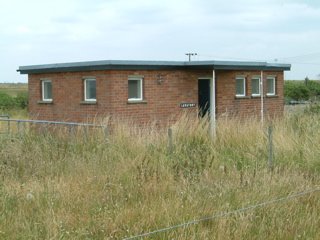 |
| Lavatory Block |
For those who want to find out more about Orfordness, I would definitely suggest a visit in the first instance. General opening times can be found on the National Trust website and I think there are still occasional guided tours where access is allowed to parts of the site not normally accessible to the general visitor.
 |
| The Black Beacon - one of very few restored structures on the site. |


